


Search spikes around “Bitcoin crash” happen for one reason. Price moves fast, and headlines follow. Investors want a clear explanation and a useful next step.
Price is one input in the Bitcoin system. It is not the only one that matters. Bitcoin keeps producing blocks. Transactions keep settling. Mining continues to convert energy into measurable output.
This article explains how to think clearly during price drawdowns and why infrastructure-based exposure stays relevant when markets reset.
Most “crash” searches come from people trying to answer two questions.
What changed in the market?
How long does the move last?
The problem is that price explanations often stop at narratives. Narratives change daily. Bitcoin’s system runs on rules, incentives, and physical infrastructure that keep operating through every cycle.
A useful frame considers market repricing as an ongoing process that occurs frequently, while system output continues steadily each day.
Bitcoin’s price reflects moves in liquidity, positioning, and risk appetite, which adjust quickly during periods of market stress.
The network itself continues to operate as designed. Blocks are produced on a fixed schedule, issuance remains unchanged, and value transfers settle continuously. Mining secures the system through measurable work that persists independently of price movements.
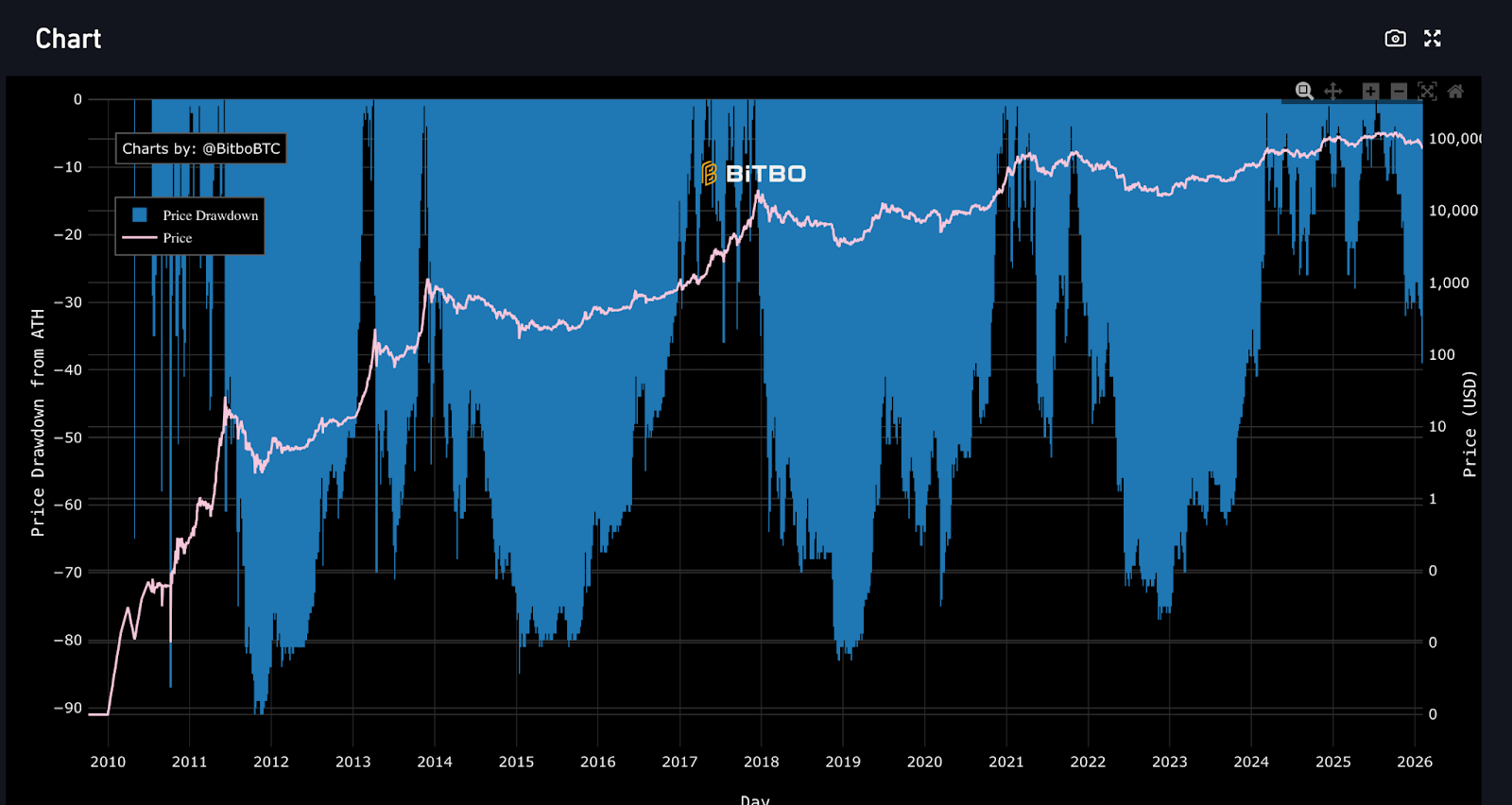
The chart shows repeated price drawdowns alongside uninterrupted block production. Market volatility reflects shifts in risk appetite, while network operation and issuance remain unchanged.
This relationship is examined in Bitcoin as a Productive Hedge With Real Yield, where mining is treated as a producing system with measurable output.
Spot exposure tracks market price. That is the design. It is clean, liquid, and direct.
Infrastructure-based exposure behaves through operations. Mining output depends on energy cost, uptime, and fleet efficiency. These inputs can be managed through contracts, monitoring, and disciplined maintenance.
This distinction matters during drawdowns because it changes what you measure. Spot exposure is measured by price. Mining exposure is measured by output and unit economics.
Mining can then be evaluated using operating models. Cash flow projections, cost structures, uptime targets, and lifecycle planning become the primary analytical tools.
Mining reaches institutional quality when it operates as infrastructure. This requires long-duration inputs, controlled operating conditions, and measurable performance. Mining fits this framework when energy is secured through defined pricing and delivery terms, operations are engineered for sustained uptime and thermal stability, and performance drivers are tracked over time.
Under these conditions, output becomes a function of execution rather than market conditions. Production remains observable and consistent across market cycles, which explains why mining can retain relevance for allocators during drawdowns.
Energy is the primary operating input in mining. Well-structured operations treat energy as a foundational constraint rather than a variable expense. Price visibility, stable load behaviour, and defined curtailment terms allow sites to plan maintenance, align hardware lifecycles, and forecast unit economics with precision.
This is where mining outcomes diverge. Fleets with similar hardware can deliver materially different results due to differences in energy structure and operational discipline. During drawdowns, these differences surface clearly as cost bases, uptime control, and operational stability are tested under changing conditions.
Visual fit: Yes. An energy price band chart or cost-per-kWh comparison by contract type.
Mining output is a direct function of uptime. At scale, uptime becomes a financial variable because each hour offline reduces cumulative output and extends capital recovery timelines. Persistent downtime alters the relationship between deployed capital and Bitcoin produced.
Operational discipline also governs hardware longevity. Stable thermal conditions reduce failure rates. Planned maintenance limits unplanned interruptions. Structured hardware rotation preserves efficiency across the fleet.
In institutional mining, execution quality determines outcomes. Execution is observable, measurable, and repeatable, which places mining within an infrastructure operating model rather than a price-driven exposure.
During drawdowns, investors benefit from a structured checklist that focuses analysis on fundamentals rather than market noise. The following questions help anchor the evaluation in operating reality:
This framework keeps the assessment disciplined and evidence-based. It shifts attention away from short-term price movements and toward the variables that determine output over time. It also mirrors how infrastructure capital evaluates long-duration assets under stress.
Bitcoin drawdowns sharpen analytical focus. Price volatility brings underlying structures into clearer view and highlights which systems continue to perform under pressure.
Mining exposure retains value when it is built on infrastructure fundamentals. Defined energy structure, engineered uptime, disciplined operations, and consistent reporting determine whether output remains stable across cycles.
Investors who centre their evaluation on these factors anchor decisions in execution rather than sentiment, improving outcomes over time.


