


Bitcoin is often described as a digital asset, yet its production follows a structure similar to commodity extraction. New supply enters circulation through mining, where computational work secured by energy generates Bitcoin in accordance with protocol rules. Understanding mining through a production lens helps clarify how scarcity, cost, and competition shape the network.
Commodity markets rely on production systems that transform physical inputs into tradable outputs. Oil requires drilling and refining. Metals require extraction and processing. Bitcoin requires computation supported by specialised hardware and electricity. Mining infrastructure performs this function by validating blocks and producing new Bitcoin as a reward. The network therefore operates as a distributed production system in which capital and energy convert into digital output.
More than 20 million Bitcoin have now entered circulation, bringing total supply close to the protocol’s fixed limit of 21 million units. New supply is introduced through block rewards earned by miners. Producing Bitcoin requires electricity, mining hardware, cooling systems, and operational infrastructure.
These inputs create measurable production costs that vary with energy prices, hardware efficiency, and operational discipline. As in commodity markets, the cost structure influences which producers remain competitive.
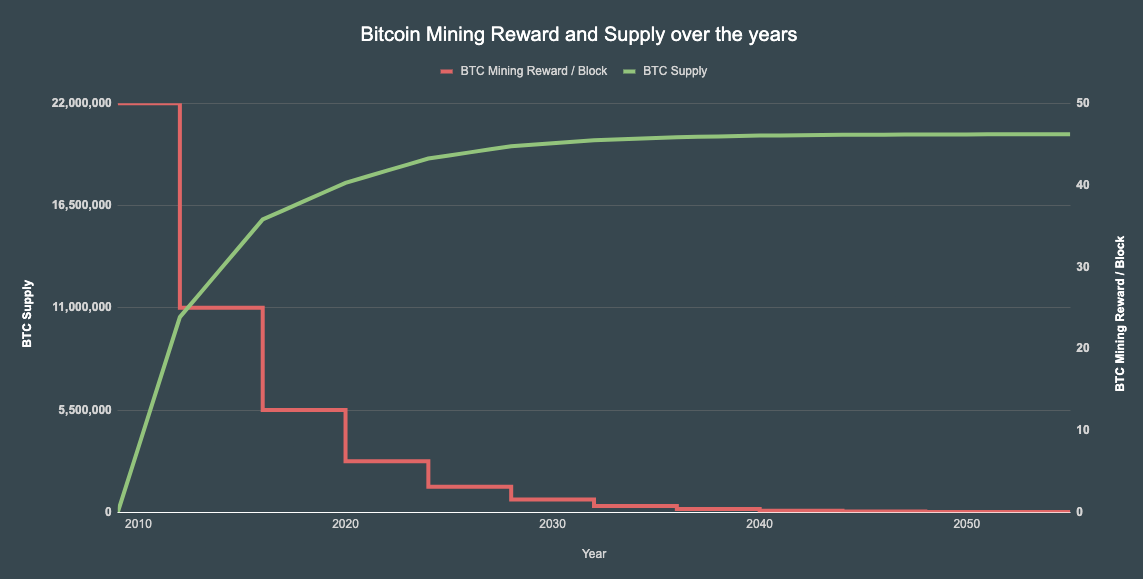
The chart illustrates Bitcoin’s programmed issuance schedule. Block rewards decline through periodic halving events while total supply gradually approaches the 21 million limit. This predefined structure ensures that new supply enters circulation at a decreasing rate over time.
The Bitcoin protocol regulates the issuance of new coins through automatic difficulty adjustment. Mining difficulty increases or decreases in response to changes in the total network hashrate. This mechanism keeps block production near its target interval and ensures that supply expands according to a predictable schedule. Difficulty, therefore, acts as a structural constraint that governs production conditions across the network.
Mining operates as a global competitive production market. Participants deploy capital, energy, and infrastructure to produce Bitcoin at the lowest possible cost, which highlights the importance of making capital efficiency a key factor in mining performance. Producers with efficient energy contracts and modern hardware maintain stronger margins, while higher-cost operators face pressure as network competition increases. Over time, marginal production cost becomes an important reference point for understanding mining economics.
Bitcoin mining combines scarcity, production inputs, and competitive dynamics within a rule-based system. Energy, infrastructure, and capital interact to produce a scarce digital commodity under transparent protocol rules. Viewing Bitcoin through this production framework clarifies how supply enters the market and how mining economics influence the network’s long-term structure.
Read relevant articles:
• Participating in Bitcoin’s Issuance
• Capital Efficiency in Bitcoin Mining
• Owning Bitcoin vs Producing Bitcoin

Grow your wealth with Pantheon Bitcoin mining. Providing sustainable Bitcoin returns for private and institutional investors.


