
Introduction
Capital efficiency determines the quality of long-duration investments. In Bitcoin mining, capital is deployed into infrastructure that converts energy into digital output under fixed protocol rules. The durability of returns depends not on narrative cycles but on how effectively that capital is structured, operated, and maintained.
Evaluating mining through capital efficiency clarifies its role within institutional portfolios.
Capital Deployment and Structural Commitment
Mining requires upfront allocation to physical infrastructure, hardware fleets, energy procurement, and operational systems. This capital is committed before output is realised. Performance, therefore, reflects the relationship between total deployed capital and the Bitcoin produced over time.
Unlike passive exposure, mining embeds capital inside a competitive production environment. The protocol defines issuance. Operators compete to convert inputs into outputs within that constraint. Efficiency determines which capital bases remain productive.
Efficiency as a Measurable Variable
Capital efficiency in mining is observable through unit economics. Cost per Bitcoin produced, energy expenditure per unit of output, and infrastructure productivity provide clear signals of performance quality. These variables are not abstract. They derive from contract structure, hardware capability, and operational discipline.
Transparent network data further reinforces this measurability. Difficulty adjustment, issuance rate, and total network hashrate are public. Capital deployed into mining operates within a system where both constraints and outcomes are visible.
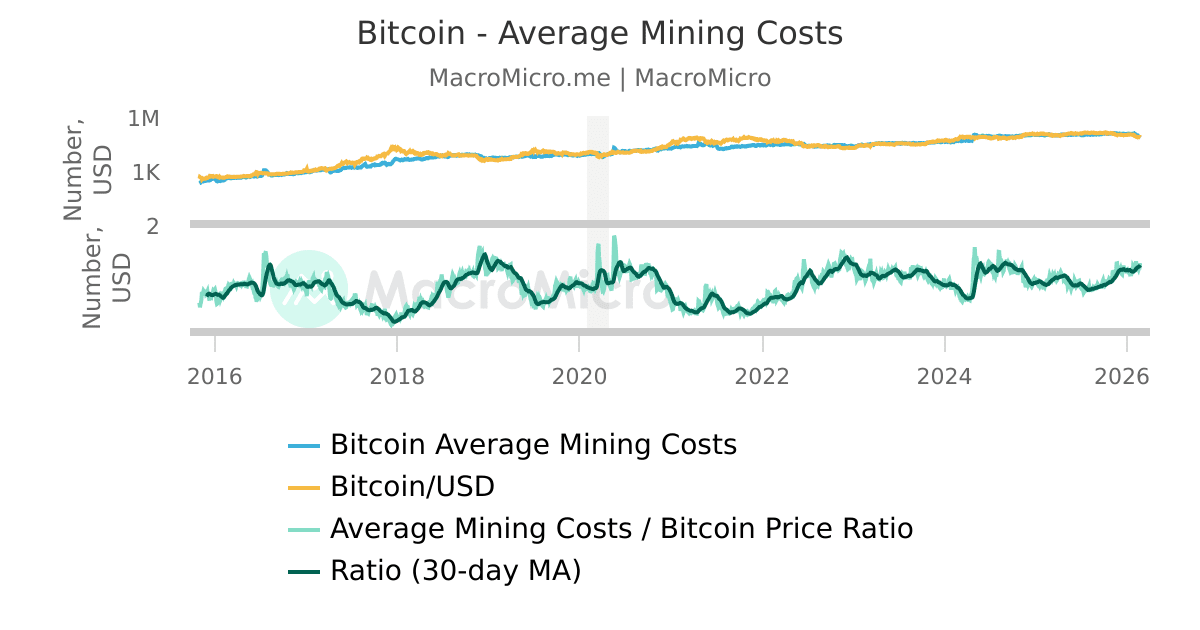 Figure 1: Bitcoin Average Mining Cost and Market Price (Source: MacroMicro)
The chart shows the relationship between estimated average mining costs and Bitcoin’s market price over time. Mining costs trend upward as network competition and capital intensity increase. Market price fluctuates more visibly.
The cost-to-price ratio illustrates how production economics adjust over the business cycle. This demonstrates that mining efficiency can be assessed using observable unit economics, with cost structure and market reference remaining transparent.
Compounding Through Operational Discipline
Operational quality shapes cumulative performance. Stable energy pricing improves margin stability. Engineered uptime increases production continuity. Hardware efficiency enhances output relative to consumption.
Small differences across these inputs produce material divergence over extended operating periods. Capital allocated into disciplined systems accumulates output more effectively, improving recovery timelines and long-term contribution to portfolio performance.
This compounding effect originates at the operational layer rather than the market layer.
Recovery, Duration, and Structural Resilience
Mining is evaluated across operating cycles defined by protocol issuance and cost structure. Recovery timelines depend on deployment cost, ongoing expenditure discipline, and production consistency. Capital structures aligned with durable energy agreements and lifecycle planning demonstrate greater resilience. The structural risks that undermine large-scale operations are examined in Why Mining Returns Fail at Scale and How Infrastructure Preserves Them.
In this environment, efficiency serves as a risk-management mechanism. It constrains downside exposure by anchoring performance to controllable inputs rather than external pricing assumptions.
Allocation Implications
For allocators, mining represents structured capital participation inside a fixed monetary system. Assessment should prioritise capital intensity, cost discipline, operational transparency, and infrastructure durability.
Capital efficiency determines whether mining contributes as a productive allocation within a broader portfolio framework. Institutions that evaluate these variables directly align exposure with measurable performance drivers.
Durability Through Efficiency
Bitcoin mining embeds capital within a rule-based production system. Efficiency governs output. Discipline governs durability.
Investors who assess mining through capital efficiency evaluate exposure through structured execution and measurable economics, positioning capital within a competitive framework defined by transparent monetary rules.

Grow your wealth with Pantheon Bitcoin mining. Providing sustainable Bitcoin returns for private and institutional investors.
Questions? Talk to the team here.