
Every 210,000 blocks, the network reduces the number of new Bitcoin issued to miners through an event known as the halving. While this predictable issuance schedule strengthens Bitcoin’s long-term scarcity, it also raises an important question: how will the network continue incentivising miners as block rewards gradually decline?
The answer lies in Bitcoin’s economic design. As the block subsidy decreases, transaction fees, mining economics and protocol mechanisms continue supporting the incentives that secure the network. Understanding how these components interact provides investors with a broader perspective on Bitcoin’s long-term resilience and the infrastructure that underpins it.
This article explores three core pillars that support Bitcoin’s long-term security:
- Dynamic revenue
- Difficulty adjustment
- Bitcoin’s security model
Pillar 1: Dynamic Revenue
The Evolution of the Security Budget
The network’s security budget comprises the total economic incentives paid to miners for transaction validation and block production via Proof of Work. This budget is split into:
- The Block Subsidy: New units issued per block (currently 3.125 BTC).
- Transaction Fees: Market-driven compensation provided by network users.
The systematic reduction of the block subsidy necessitates a transition toward a fee-based model. High-net-worth investors focus on this shift as a metric for long-term network participation and the sustained resilience of the hashrate.
Operational discipline is critical as hashrate increases. Greater computational competition raises the threshold for successfully mining blocks, thereby enhancing network security against reorganisation attempts while demanding superior hardware efficiency and energy strategy.
Mining is increasingly becoming an infrastructure-grade activity, where profitability is determined by professional management rather than speculative cycles.
Revenue Resilience and Market Dynamics
Historically, the reduction in Bitcoin-denominated rewards has been offset by price appreciation and increased hashrate. Institutional research indicates that while the nominal block reward declines, the USD-denominated value has maintained significant growth across multiple halving cycles.
Recent institutional research highlights this relationship by comparing the decline in Bitcoin-denominated block rewards with miner revenue measured in US dollars. Although miners receive fewer newly issued Bitcoin today than they did during the network’s early years, the market value of those rewards has supported continued investment in mining infrastructure and contributed to the growth of the network’s total hashrate.
This trend shows that Bitcoin’s incentive model extends beyond the number of coins issued with each block. Mining economics are influenced by several interconnected factors, including Bitcoin’s market price, transaction demand, energy costs, hardware efficiency and operational performance. Energy strategy has become one of the primary drivers of long-term mining competitiveness.
Together, these variables determine how mining operations adapt as the network continues to mature.
Key performance variables for modern mining infrastructure include:
- Secured, long-term energy procurement.
- Advanced hardware lifecycle management (ASIC efficiency).
- Diversified revenue through demand response and grid-balancing agreements.
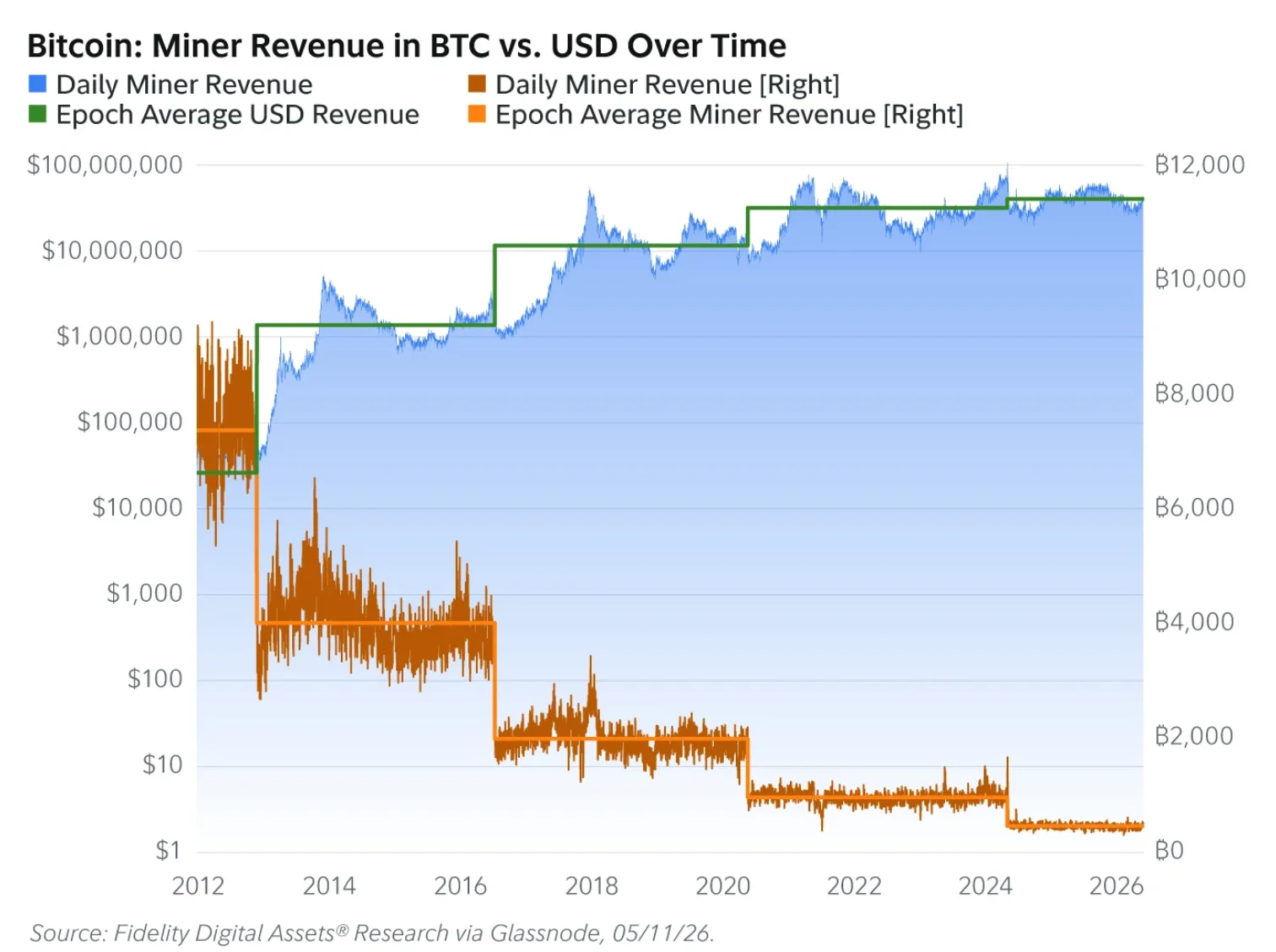
Figure 1. Miner revenue in BTC vs. USD over time (Fidelity Digital Assets Research)
While the Bitcoin-denominated block subsidy declines after each halving, miner revenue measured in US dollars has generally increased over time. This illustrates how miner economics are influenced by more than the number of Bitcoin issued, with market value playing an important role in sustaining investment across successive halving cycles.
Pillar 2: Difficulty Adjustment
Understanding the difficulty adjustment
Bitcoin’s security depends on miners contributing computing power to validate transactions and produce new blocks, while the amount of computing power securing the network naturally changes over time as miners respond to market conditions, hardware upgrades and energy costs, so to maintain a consistent rate of block production Bitcoin automatically adjusts mining difficulty approximately every 2,016 blocks, or roughly every two weeks, a mechanism that also helps preserve Bitcoin’s predictable issuance schedule as explained in our article on participating in Bitcoin’s issuance through mining.
The difficulty adjustment (the protocol mechanism that recalibrates how difficult it is to produce a valid block) helps maintain an average block interval of around ten minutes regardless of changes in active mining participation. When more computing power joins the network, mining becomes more difficult. When mining participation decreases, the protocol lowers difficulty during the next adjustment period, allowing block production to gradually return towards the network’s ten-minute target.
This automatic adjustment is one of Bitcoin’s defining protocol mechanisms because it allows the network to respond to changing mining conditions without manual intervention. As participation changes, the protocol continues targeting a predictable block production schedule using predefined rules that have operated continuously since Bitcoin launched.
The difficulty adjustment also helps maintain competitive mining conditions by recalibrating block production as network participation changes. This creates an environment in which efficiency, infrastructure quality and hardware lifecycle management remain important factors in long-term mining performance.
Pillar 3: Bitcoin’s Security Model
Understanding Bitcoin’s security model
Bitcoin’s security is often discussed in terms of a 51% attack, a situation in which a single miner or a coordinated group controls the majority of the network’s computing power. While the term is widely used, it is also frequently misunderstood.
Controlling the majority of Bitcoin’s hashrate does not give an attacker unlimited control over the network. Full nodes (computers that independently verify Bitcoin’s rules) continue enforcing the consensus rules, including the 21 million Bitcoin supply limit, block validation requirements and transaction verification. These rules cannot be changed simply by controlling more mining power.
A majority of hashrate could allow an attacker to extend a longer valid chain to replace recent blocks or attempt a double-spend attack (reversing a recently confirmed transaction to spend the same Bitcoin again). These attacks become progressively more difficult as additional blocks are confirmed because an attacker must recreate the proof of work for the targeted block and every block that follows it.
This distinction is important because Bitcoin’s security relies on both economic incentives and protocol rules. Miners secure the blockchain through proof of work, while full nodes independently verify that every block complies with the network’s consensus rules. Together, these mechanisms create a system where network participants operate under transparent rules that apply equally across the network.
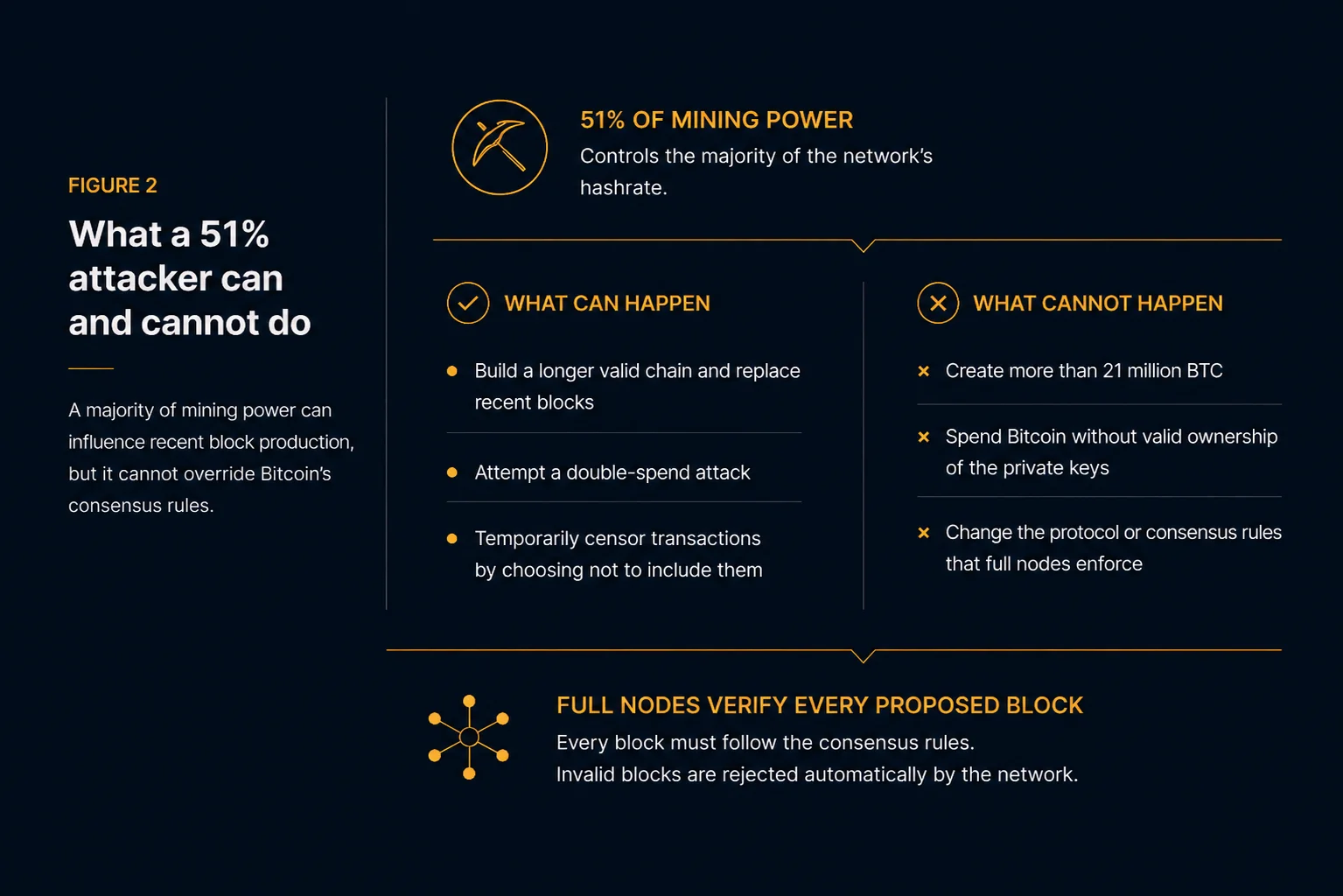
Figure 2. What a 51% attacker can and cannot do (Source: Diagram created by Pantheon Mining. Technical concepts based on the Bitcoin Whitepaper (2008), Bitcoin Core documentation and the Bitcoin Developer Guide)
A 51% attack can influence recent block production but cannot override Bitcoin’s consensus rules. Full nodes continue independently validating every proposed block, ensuring that invalid blocks are rejected regardless of who mines them.
Why transaction fees become increasingly important
Every Bitcoin block has limited space, meaning not every pending transaction can be included immediately. Users voluntarily attach transaction fees to their transactions, and miners generally prioritise those offering higher fees when selecting transactions for inclusion in a block. This creates a competitive market for block space during periods of higher network activity.
As the block subsidy gradually declines, transaction fees are expected to represent a larger share of miner revenue. This transition has been part of Bitcoin’s design since launch, allowing miner compensation to gradually evolve as Bitcoin usage and demand for block space develop over time.
Recent network activity has demonstrated how this mechanism operates in practice. During the 2024 halving, block 840,000 generated approximately 37.6 BTC in transaction fees compared with a 3.125 BTC block subsidy, illustrating how strong demand for block space can significantly increase miner revenue during periods of heightened activity. Block 840,000 represented an exceptional period of network demand and should not be viewed as a typical distribution of miner revenue.
The event nevertheless demonstrated how Bitcoin’s fee market responds when many users compete for inclusion in the same block. As adoption, settlement activity and on-chain demand continue to develop, transaction fees remain an increasingly important component of Bitcoin’s long-term incentive model.
Investment Outlook
Bitcoin’s security is supported by transparent protocol rules, market-based incentives and continuously adjusting mining economics. Understanding how these mechanisms work provides investors with a broader perspective on the infrastructure that secures the network and the factors that influence mining over the long term.