
Most investors who evaluate Bitcoin exposure treat it as a single decision. The question is usually framed as how much to allocate to Bitcoin, and the answer involves buying spot Bitcoin or accessing it through an ETF. Managed mining changes the nature of that decision entirely, changing the structure of the exposure alongside the size of the position. This article covers the two roles Bitcoin exposure can play in a portfolio and the four variables that determine the right allocation size.
Two types of Bitcoin exposure, two different portfolio roles
Buying Bitcoin through a spot purchase or an ETF gives an investor price exposure. The position is valued at the prevailing market price, rises and falls with the market, and carries a cost basis fixed at the entry price on the day the capital is deployed. Producing Bitcoin through managed mining provides an investor with production exposure, where the effective cost basis is determined by energy costs and infrastructure quality, independent of the market price on any given day.
A spot Bitcoin position is a passive holding that responds to market price and a managed mining position is an operating infrastructure investment that generates daily output at a cost determined by the energy contract and the operation's hardware efficiency. Understanding that distinction is the starting point for sizing each type of exposure within a broader allocation.
Related: Owning Bitcoin vs Producing Bitcoin
The production cost basis and what it means for portfolio risk
In commodity portfolio construction, the relationship between market price and production cost is a core analytical input. Gold mining companies are evaluated partly on their all-in sustaining cost relative to the gold price because that relationship determines the margin available to the operation across different price environments, and Bitcoin managed mining follows the same logic.
Charles Schwab's research division identified efficient miner production costs at approximately $60,000 per BTC and inefficient miner production costs at approximately $95,000 per BTC as of May 2026, based on Glassnode data. The $35,000 gap between those two benchmarks reflects the difference between operations with fixed, long-term energy agreements and those exposed to spot electricity markets. For portfolio construction purposes, that gap is the risk differential between a managed mining position built on infrastructure discipline and one that carries uncontrolled cost exposure.
Related: Charles Schwab: cost of producing Bitcoin as a valuation metric
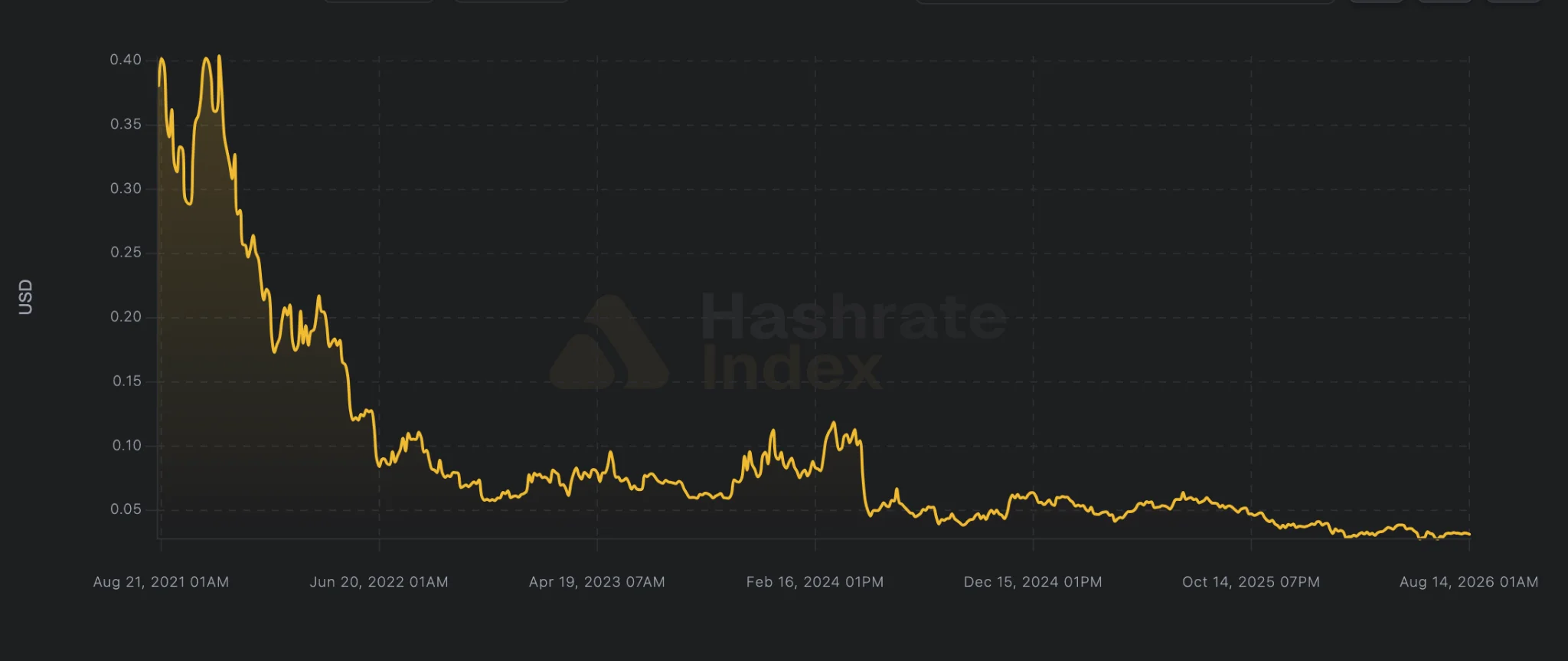
Figure1: Bitcoin hashprice index, long-term trend (source: hashrateindex)
This chart shows USD revenue per terahash per second over the past five years, illustrating the long-term downward pressure on mining revenue per unit of computing power. For operations exposed to spot electricity markets, a declining hashprice directly compresses margins, and operations with energy costs fixed under long-term contracts hold their cost base steady regardless of where hashprice sits at any point in the cycle.
The four variables that determine allocation size
Allocation sizing in managed mining follows a framework built around four variables that are specific to each investor's situation.
- Liquidity. Managed mining is an infrastructure commitment with a defined investment horizon. Investors with significant near-term liquidity requirements should size the allocation accordingly, acknowledging its illiquid nature across the investment horizon.
- Existing Bitcoin exposure. An investor who already holds spot Bitcoin or ETF exposure is adding a production layer to an existing directional position. An investor with no prior Bitcoin exposure is building initial exposure through the production route. The sizing logic differs in each case and the two types of exposure complement each other within the same portfolio.
- Tax treatment. Bitcoin produced through managed mining is treated as income upon receipt in most jurisdictions, with capital gains treatment applying to any subsequent appreciation. The effective after-tax cost basis of the production position should be modelled against the investor's specific tax situation before sizing decisions are made.
- Minimum viable production scale. Entry from five miners is the practical floor for a Pantheon managed mining allocation. The appropriate scale above that floor is a function of the first three variables and the investor's target Bitcoin accumulation trajectory across the investment horizon.
The time structure works in the investor's favour
A managed mining allocation carries a defined time structure that is absent from spot Bitcoin or ETF exposure. The productive life of ASIC hardware, the term of the energy contract, and the halving schedule all create a temporal framework that determines how the position performs across different market phases.
The 2028 halving will cut daily issuance from 450 BTC to 225 BTC across the entire network, permanently reducing the production rate of every operation running after that date. Capital deployed before the halving participates in the higher production rate for the remainder of the pre-halving window, which closes in April 2028. The production schedule is known, the halving date is fixed, and the investor can model the Bitcoin accumulation trajectory across the full investment horizon without reference to market price predictions.
What this means for a serious portfolio
Portfolio construction is about matching instruments to investment objectives across the full investment horizon. For investors with a multi-year horizon, tolerance for an infrastructure commitment, and an existing or intended Bitcoin allocation, managed mining adds a production layer that changes the economics of the allocation and keeps the underlying asset exposure intact.
The position produces Bitcoin at a cost basis set by energy infrastructure, compounds daily output across every phase of the cycle, and carries terminal value in the physical assets at the end of the miner's life. The current available allocations, project details, and production economics are on the projects page.
Explore active Bitcoin mining projects managed by Pantheon. View Projects