
Bitcoin’s mining network recently demonstrated the importance of energy strategy in long-term mining performance. The network's difficulty fell 10.09% in mid-June 2026, from 138.96T to 124.93T, the protocol's self-correcting response to a decline in active hashrate following a roughly 15% drop in Bitcoin's price earlier in the month. What it revealed about operator quality is the more important story.
The Adjustment, in Context
According to The Block, citing Galaxy Research, this was the 11th-largest downward difficulty adjustment in Bitcoin's history and the second-largest of 2026, following an 11.16% cut in early February. The cut hands every miner that stayed online roughly 11% more Bitcoin per unit of active hashrate. Hashprice subsequently recovered to approximately $33.68 per petahash per second per day, according to The Block, after falling below $28 during the June adjustment period.
The mechanism behind this is one of Bitcoin's defining strengths. Every 2,016 blocks, roughly every two weeks, the protocol recalibrates automatically to keep block production steady at close to ten minutes per block, regardless of how much hashrate is active on the network. No central authority adjusts it. No company controls it. The previous adjustment cycle ran 15.6 days against the standard 14-day target, the exact condition that triggers a downward correction, and the system responded precisely as it has, without interruption, since 2009.
Related: The ASIC Hardware Lifecycle: What Every Bitcoin Mining Investor Needs to Know
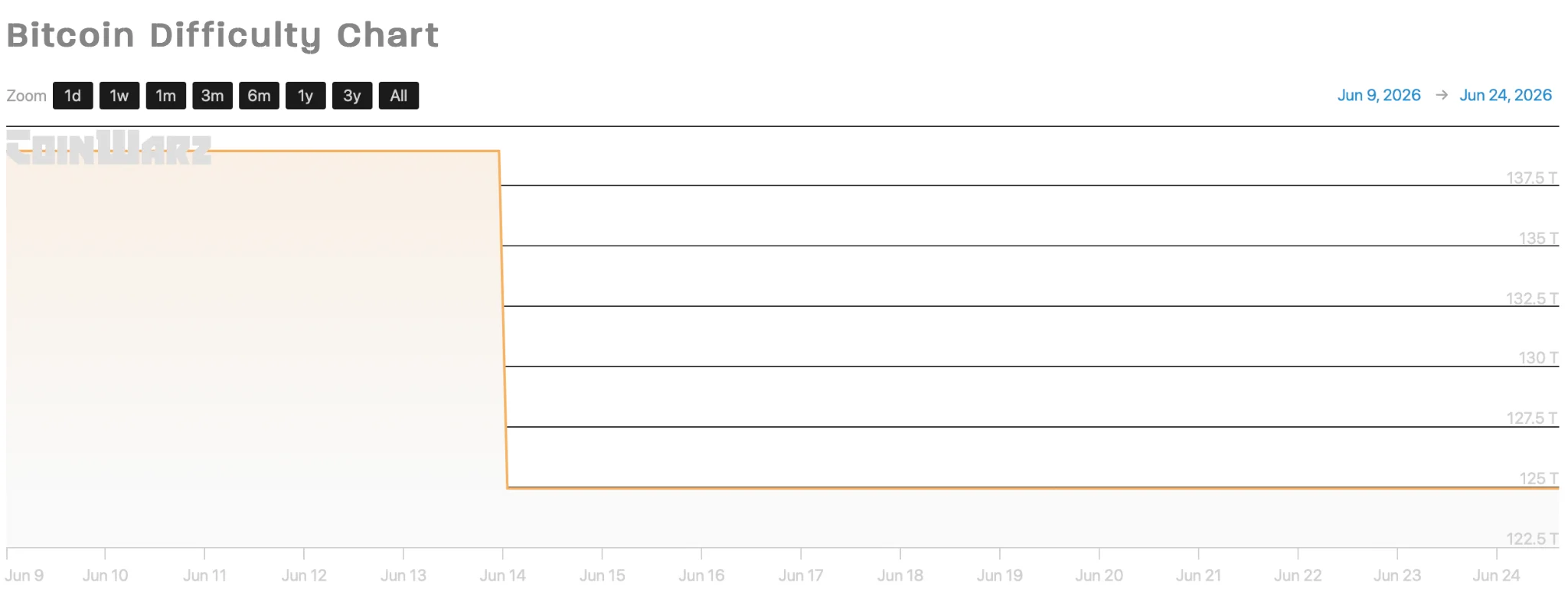
Figure1: Bitcoin mining difficulty adjustments, CoinWarz
This chart shows the consistent pattern of difficulty adjustments through the current cycle, illustrating how the protocol continuously recalibrates to reflect real network conditions without any external intervention.
What Separates the Best-Positioned Operations
The adjustment highlighted the importance of cost structure across mining operations. According to The Block, smaller operations running older-generation hardware and facing higher electricity costs were the most exposed during the period of margin pressure that preceded the adjustment, while better-capitalised operations with efficient hardware and lower energy costs were positioned to absorb the same pressure with far less disruption.
A long-term energy strategy provides a structural advantage for mining operations. Fixed, long-term power agreements and owned generation assets establish a stable cost structure over the life of the investment. This approach limits exposure to short-term margin compression and supports consistent operational performance during changing market conditions. Energy ownership and long-term contracts reduce dependence on spot electricity markets, allowing operations to maintain production through periods of network adjustment and price volatility.
Related: Why Energy Contracts Matter More Than Hashrate in Bitcoin Mining
Why Jurisdiction Selection Matters More Than Ever
This advantage is also why jurisdiction selection has become a strategic decision rather than an afterthought. Locations with abundant low-cost renewable or hydro power, supportive government infrastructure investment, and long-term policy stability are the jurisdictions where mining operations can secure the kind of fixed, low-cost energy contracts that determine resilience through periods of margin pressure like this one. Pantheon’s Bitcoin mining Iceland project demonstrates how geothermal energy supports long-term operational stability, while its Bitcoin mining Finland project is built around renewable energy infrastructure designed for efficient, long-term production. This is the deliberate outcome of selecting locations where energy strategy and infrastructure support sustainable mining performance.
Related: Why Bitcoin Mining Profitability Is More Resilient Than Its Critics Assume
What This Confirms for Managed Mining Investors
The June 2026 adjustment provides a clear demonstration of Bitcoin’s core design strength. The network corrects itself automatically every two weeks, rewarding the operations built on genuine cost discipline and stable energy strategy. No central authority intervened. No company needed to act. The protocol simply did what it has done since 2009.
For investors evaluating a managed mining allocation, periods of margin pressure are the clearest real-world test of operator quality available. The right energy strategy, the right jurisdiction, and the right infrastructure are what separate a resilient operation from one exposed to short-term volatility.
Explore active Bitcoin mining projects managed by Pantheon. View Projects