
The Objection Every Investor Eventually Raises
At some point in every serious conversation about managed Bitcoin mining, the same question surfaces. Block rewards halve every four years, the hashrate has risen 5.53x since the May 2020 halving, and if Bitcoin's price does not keep pace, the revenue per terahash keeps falling. At what point does mining stop making economic sense?
It is a reasonable question, and it deserves a direct answer. This analysis builds on a framework outlined by Daniel Batten, extending it with a focus on how institutional-grade mining operations are already adapting to these structural shifts.
The profitability concern, as it is usually stated, rests on three assumptions that are all becoming less accurate at the same time, and understanding why those assumptions are wrong is more useful for investors than dismissing the concern outright.
What the Bear Case Actually Claims
The argument runs as follows. Hashprice, the USD revenue a miner earns per unit of computing power, is on a long-term downward trend, electricity costs are rising globally, and block rewards halve on a fixed schedule that does not respond to market conditions. If those three trends continue in parallel, mining revenue eventually falls below operating cost.
The data behind this argument is real. Hashprice has declined significantly from its 2021 peak, electricity prices in most Western markets have risen, and the 2024 halving cut block rewards from 6.25 BTC to 3.125 BTC per block, with the 2028 halving set to reduce them again.
What the argument misses is everything that has changed about how mining operations generate revenue, structure their energy costs, and position themselves within the broader Bitcoin network.
Revenue Has Already Diversified Beyond Block Rewards
The profitability concern assumes block rewards are the primary or sole revenue source for mining operations, an assumption that was broadly accurate in 2018 and is no longer accurate in 2026.
Mining operations today generate revenue across several distinct streams alongside block rewards. Demand response services, where a miner agrees to curtail energy consumption during grid stress events in exchange for payment from the grid operator, can generate returns that exceed mining revenue during peak demand periods, with operations in Texas already demonstrating this at commercial scale. Heat recycling represents a second stream now functioning at a meaningful scale, with exhaust heat from mining hardware being captured and redirected for residential heating, greenhouse operations, and industrial drying processes. District heating projects in Finland now supply approximately 80,000 residents using heat generated from Bitcoin mining operations.
Renewable Energy Certificates and carbon credit frameworks provide a third stream available to operations drawing from certified renewable sources, carrying direct commercial value as ESG reporting requirements tighten across European institutional portfolios. Operations that face genuine profitability pressure in a declining hashprice environment are those treating mining as a single-revenue activity while purchasing electricity at market rates, and that model has already been superseded.
How infrastructure structure determines whether returns hold at scale is examined in Why Mining Returns Fail at Scale and How Infrastructure Preserves Them.
Energy Ownership Changes the Cost Equation Permanently
The second assumption in the bear case is that rising electricity prices will continue to erode margins, which holds only for operations buying electricity at spot or short-term contract rates.
Long-term energy agreements signed for periods of five to twenty years fix the primary cost variable for the duration of the contract. A mining operation with a ten-year power purchase agreement negotiated before the current energy price cycle is structurally insulated from the cost pressure the bear case describes, and operations that own their energy generation assets directly remove electricity price risk entirely over an asset life spanning two decades.
This is directly relevant to geography. Norway's hydropower infrastructure operating under long-term concession agreements and the UAE's solar generation economics both support the kind of fixed, low-cost energy structures that the bear case assumes are unavailable. They are available, and they form the basis on which institutional-grade managed mining is built.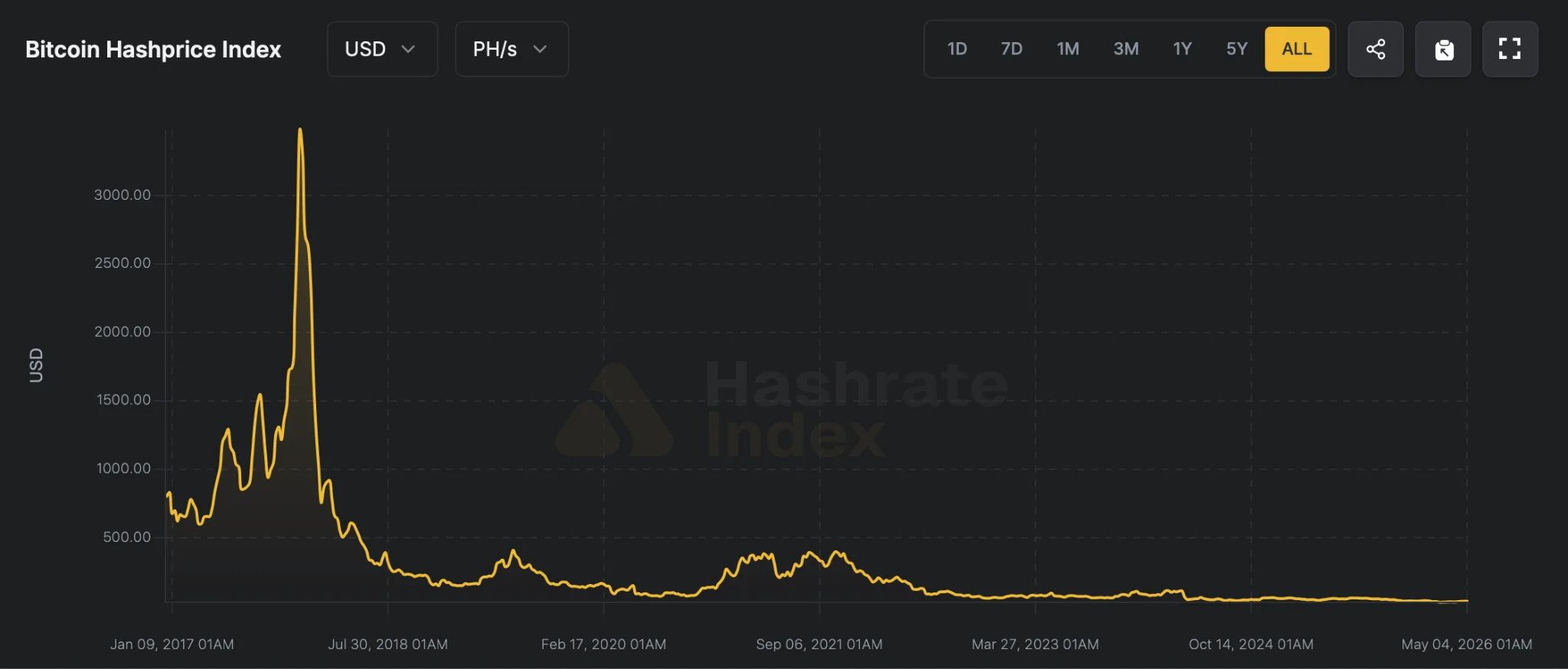
Figure 1: Bitcoin hashprice long-term chart showing the declining trend alongside mining revenue per terahash (Hashrate Index)
The role of energy contract structure in determining long-term mining performance is examined in detail in Why Energy Contracts Matter More Than Hashrate in Bitcoin Mining.
The Network Has a Non-Economic Floor
The third assumption is that economic self-interest is the only reason anyone mines Bitcoin, leading to the conclusion that unprofitable mining means zero mining and a collapsing network. The observable evidence points elsewhere.
There are currently between 50,000 and 60,000 publicly reachable Bitcoin nodes, and many participants behind those nodes are not mining for profit. Home miners, solo miners, and participants in the Bitaxe open-source mining movement operate at electricity costs that commercial operations would consider loss-making, doing so because they regard participation in network security as worth the cost independently of financial return. Solo miners operating without pools have won blocks in recent cycles despite the statistical improbability.
The ideological component of mining participation provides a structural floor beneath the commercial network that persists regardless of hashprice, and it is a floor that no standard profitability model captures. Demand response, heat recycling, AI compute revenue, energy ownership, and non-economic participation are all deployed and operating today, meaning the security budget debate as originally formulated is describing a version of the mining industry that no longer exists.
What This Means for Managed Exposure
For investors evaluating managed Bitcoin mining, the profitability question resolves into a more specific one: which operations are structured to remain viable through the next halving cycle and beyond?
The answer is operations that have secured fixed long-term energy contracts or energy ownership, that generate ancillary revenue from demand response and heat recycling, and that are located in jurisdictions with regulatory stability and renewable energy abundance.
Operations built on spot electricity and single-revenue-stream economics face the pressure that the bear case describes, while operations built on the structural model above face it with considerably more resilience.
The profitability concern, properly understood, is an argument for the specific kind of managed, infrastructure-grade mining that long-term investors should be seeking regardless of where hashprice sits in any given month. Infrastructure quality is precisely the variable that separates durable exposure from commodity risk.